Mostrando entradas con la etiqueta The Trifid Nebula. Mostrar todas las entradas

lunes, 23 de junio de 2025

A New Dawn in Astronomy: The First Images from the Rubin Observatory

 In a remarkable testament to human ingenuity, collaboration, and our unyielding quest for knowledge, the Vera C. Rubin Observatory has released its first images of the cosmos. These breathtaking visuals are not just snapshots of distant celestial bodies; they represent the culmination of years of meticulous planning, overcoming challenges, and pushing technological boundaries.


Located at the summit of Cerro Pachón in Chile, the observatory stands as a beacon of hope for unravelling some of the universe's most profound mysteries, including dark matter and dark energy. Named after Vera Rubin, an astronomer whose work illuminated our understanding of these enigmatic forces, the observatory is poised to transform how we perceive the cosmos.


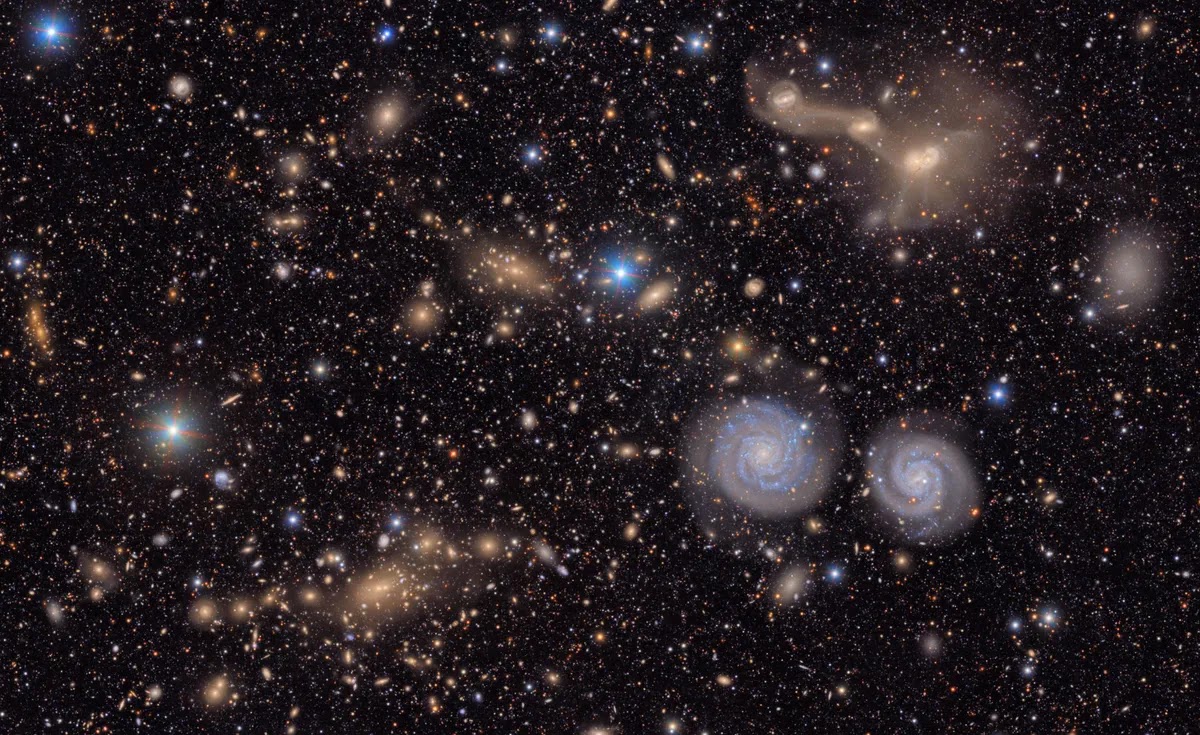
The images reveal stunning details of the Trifid and Lagoon Nebulae—vast clouds of gas and dust where new stars are born, showcasing the intricate beauty of our universe. Beyond these mesmerising nebulas, the observatory has captured parts of the Virgo Cluster, a collection of thousands of galaxies interacting in a cosmic dance billions of light-years away.


This achievement is not just about advanced technology or scientific discovery; it's a testament to human perseverance and collaboration across nations and disciplines. The challenges faced by the team—ranging from technical malfunctions to the unpredictability of weather on high mountain peaks—underscore our collective determination to explore the unknown.


As we stand on the brink of what promises to be a decade-long journey into the depths of space, let us celebrate not just the images themselves but what they represent: hope, curiosity, and an unwavering commitment to expanding the horizons of human knowledge. The Vera C. Rubin Observatory's first look is indeed a leap forward in our quest to understand the universe and our place within it.


Virgo Supercluster


An image showing 10 million galaxies, if you were to look at one galaxy per second, it would take 115 days, 17 hours, 46 minutes and 40 seconds to look at them all.


Portion of the Virgo cluster


The Trifid Nebula


lunes, 17 de septiembre de 2018

The Trifid Nebula M20

Charles Messier discovered on June 5, 1764. It is combination of an open cluster of stars; an emission nebula, a reflection nebula and a dark nebula all three in one.

This Nebula is a star-forming region in the Scutum spiral arm of the Milky Way. It is approximately 5000 ly away from Earth and It have an apparent magnitude of 6.3.

It has been a subject of an investigation by astronomers using the Hubble Space Telescope in 1997, using filters that isolate emission from hydrogen atoms, ionized sulfur atoms, and doubly ionized oxygen atom. The images were combined into a false-color composite picture to suggest how the nebula might look to the eye.

File Data


Photo by: Francisco Silva
Scheduled by: SeanTO.2017
Observation date: Thursday, September 6, 2018
Observation time: 4:35 pm EDT / 1:35pm PDT / 20:35 UTC
Observatory: Slooh Canary Islands
Telescope: Canary One
Instrument: Canary Half Meter


Photo by: Francisco Silva
Scheduled by: SeanTO.2017
Observation date: Thursday, September 6, 2018
Observation time: 4:36 pm EDT / 1:36 pm PDT / 20:36 UTC
Observatory: Slooh Canary Islands
Telescope: Canary One
Instrument: Canary Half Meter


Photo by: Francisco Silva
Scheduled by: SeanTO.2017
Observation date: Thursday, September 6, 2018
Observation time: 4:38 pm EDT / 1:38 pm PDT / 20:38 UTC
Observatory: Slooh Canary Islands
Telescope: Canary One
Instrument: Canary Half Meter