It has not been bad at all and I recognize that a lot of the toxicity has finished but there is still a lot to do
I didn't get past bronze but I also admit that I haven't played enough

It has not been bad at all and I recognize that a lot of the toxicity has finished but there is still a lot to do
I didn't get past bronze but I also admit that I haven't played enough
The book aims to simplify complex psychological theories and ideas for readers who want a basic understanding of the subject. It covers a range of topics including brain anatomy, emotions, personality, cognition, perception, motivation, mental disorders, social psychology and more.
The book is organized into 14 chapters, each focusing on a different topic. Each chapter contains illustrations, diagrams, and easy-to-read explanations of key concepts, experiments, and theories. The book also includes biographical pages of influential psychologists such as Sigmund Freud, B.F. Skinner, and Carl Rogers.
The language is easy to understand and does not require prior knowledge about the subject. The book provides a comprehensive introduction to psychology as a field of study and is suitable for readers of all ages and backgrounds.
Overall, "Big Ideas Simply Explained: Psychology" is a helpful resource for anyone looking to learn about the basics of psychology in a clear and concise manner.
The Perfect Companion for playing Age of Empires IV
Age of Empires IV marks the long-awaited continuation of a beloved series―a new era in historical strategy games is finally here. Future Press is proud to present a companion book to accompany this landmark in the genre, created in close collaboration with the teams at Relic Entertainment and World’s Edge studio. We’ve carefully put together a mixture of art, strategic guidance and behind-the-scenes content that is certain to enrich your time with the game. Across 400 pages, the book dives into the game’s civilizations, units, buildings and maps, blending strategy with developer commentary and artwork.
Stats and Strategies
Age of Empires IV offers a rich strategic battleground in which every building, unit and map has its own tactical considerations, all within the unique frameworks of the game’s eight civilizations. Everyone, from RTS beginners to Age of Empires experts, will find the mixture of detailed stats and tactical advice invaluable as they dive into this incredibly deep game.
The Art of Age of Empires IV
Every chapter in the book is peppered with concept art and early renders, giving an insight into the game’s creation and artistic direction, and renowned digital artist Craig Mullins’ gorgeous series of Age of Empires IV and franchise artworks are featured in an extraordinary interview showcase section.
Developer Commentary
The book is infused with developer commentary, resulting from interviews with various members of the development team, all carefully placed to add background and context. Learn how three teams collaborated across art, narrative, audio, game design and balance to create a rich and ambitious RTS game with a unique approach to historical presentation.
Overwatch has been a game that was constantly changing, from power-ups to nerfs with new heroes and maps.

Finding a group of humans that were compatible was almost impossible but that for me was the most fun.
In 2019 Overwatch 2 was announced and it was all crazy with delays, stories, and administrative chaos at Blizzard.
But after all this, here we are... And even though I've already played the beta, I reserve my opinions on Overwatch 2 for the following publication.
Those of you who follow me know that Bastion is my favourite character and I know very well that not everyone shares this point of view.
After I have played 4213 games, with a used time of 525 hours I reached silver level 56, of those 525 hours, I played 385 as Bastion.
The amount of memories I have is immense, from the most ridiculous deaths to the most impressive feats (these last ones happened little) the hours spent with friends and in lan centre playing, ordering pizzas or ramen, drinking all kinds of energy drinks to give the 100%, great moments...


Here are some screenshots of my profile, as proof that I was there.


I hope to see you all in Overwatch 2

The night sky feels a little quieter today. With the official end of its scientific operations in late 2022, the Stratospheric Observatory for Infrared Astronomy (SOFIA) took its final flight, closing the curtain on a truly remarkable era of cosmic exploration.
Born from an ambitious collaboration between NASA and the German Space Agency (DLR), SOFIA first took to the skies for scientific observations in 2010. For over twelve years, this uniquely modified Boeing 747SP—carrying a massive 2.7-meter reflecting telescope—soared above 99% of the Earth's atmospheric water vapor, granting us infrared views of the universe that were once impossible to capture from the ground.

Saying goodbye to a mission that so deeply reshaped our understanding of the cosmos is far from easy. Among its most iconic achievements, SOFIA made the groundbreaking discovery of molecular water on the sunlit surface of the Moon (within Clavius Crater), revealed the hidden magnetic fields driving the core of our galaxy, and provided extraordinary insights into star formation and planetary atmospheres.
Today, the aircraft rests quietly at the Pima Air & Space Museum in Arizona, standing as a timeless monument to human ingenuity. SOFIA’s engines will no longer roar into the stratosphere, but the infrared light it gathered will continue to illuminate our understanding of the cosmos for decades to come. Thank you for teaching us to look beyond the clouds.
This certificate recognizes my participation in training focused on ecosystem projects developed within NASA STEM. As a STEAM educator, integrating this content strengthens my ability to explain how ecological systems respond to environmental changes, how they are monitored from both the ground and space, and how this data helps us understand the health of the planet.

Is a comprehensive overview of the southernmost continent on Earth. The book details the geography, wildlife, and history of Antarctica in great detail, presenting readers with everything they need to know about this remote and mysterious part of the world.
The day begins by outlining the physical characteristics of Antarctica, describing everything from its extreme climate to its unique geological features. He then goes on to introduce readers to the many different species of animals that inhabit the continent, including penguins, seals, and whales. Alongside this, Day explores the importance of Antarctica in the global ecosystem and its role as a research centre for scientists studying topics such as climate change.
The author also delves into the historical aspect of Antarctica, detailing the many expeditions that have been undertaken to explore the region, including those led by early explorers such as Robert Falcon Scott and Ernest Shackleton. He also looks at the political history of Antarctica, including its role in the Cold War and the formation of treaties that dictate how the continent can be used today.
Overall, Antarctica provides a comprehensive and informative guide to one of the most fascinating and important parts of the planet. Day’s writing is clear and engaging, making it an enjoyable read for anyone with an interest in geography, nature, or history.
This certificate recognizes my participation in training for the Sally Ride EarthKAM program, an initiative that enables students to capture images of Earth from the International Space Station. As a STEAM educator, integrating this material strengthens my ability to explain how orbital photography serves as a powerful tool for studying geography, climate, and environmental changes.

This certificate recognizes my participation in a training session dedicated to the Lunar Reconnaissance Orbiter (LRO) and the global celebration of International Observe the Moon Night 2022. As a STEAM educator, integrating this content strengthens my ability to explain how observing the Moon—from ground-based telescopes to orbiting probes—enables us to understand its geology, evolution, and potential for future missions.

This certificate recognizes my participation in training focused on the science to be conducted on the lunar surface during the Artemis missions. As a STEAM educator, integrating this content strengthens my ability to explain how the Moon serves as a natural laboratory for studying geology, resources, radiation, and extreme conditions.

This certificate recognizes my participation in training focused on the science to be conducted on the lunar surface during the Artemis missions. As a STEAM educator, integrating this content strengthens my ability to explain how the Moon serves as a natural laboratory for studying geology, resources, radiation, and extreme conditions.

This certificate recognizes my participation in training dedicated to understanding Earth as a set of interconnected systems. As a STEAM educator, integrating this content strengthens my ability to explain how the atmosphere, geology, oceans, climate, and life form a dynamic network that sustains our world.

It is incredible to see the amount of information these images were taken with WEBB's NIRCam.
You can see many details such as the atmosphere and the Auroras, and the different concentrations, depths and heights of the clouds.

Webb NIRCam composite image of Jupiter from three filters – F360M (red), F212N (yellow-green), and F150W2 (cyan) – and alignment due to the planet’s rotation. Credit: NASA, ESA, CSA, Jupiter ERS Team; image processing by Judy Schmidt.
My favourites are the wide field view since you can see the rings, two of the natural satellites and the prize of even seeing galaxies in the background


Webb NIRCam composite image from two filters – F212N (orange) and F335M (cyan) – of Jupiter system, unlabeled (top) and labeled (bottom). Credit: NASA, ESA, CSA, Jupiter ERS Team; image processing by Ricardo Hueso (UPV/EHU) and Judy Schmidt.
But for me, the most impressive part is that these images were produced by citizen scientist Judy Schmidt from Modesto, California, and considering that the rotation of the planet is about 10 hours, these images are very extraordinary.
Is a comprehensive reference guide to J.R.R. Tolkien's fictional world of Middle-earth. It was written by David Day and was first published in 1979, and an updated and revised edition was released in 2012. The book features over 500 entries on characters, places, and items from the world of Middle-earth, including a detailed timeline and genealogy of the major characters.
The book also contains illustrations, maps, and photographs to help readers visualize the world of Middle-earth.
The entries in the book are organized alphabetically, and provide detailed information about each character or place.
The book also includes an introduction to Tolkien's life and works, and a bibliography of his works.
One of the things that I liked the most are the family trees, the chronological guide of events and the graphic art is very well done.
Overall, "An Encyclopedia of Tolkien" is a valuable reference guide for fans of J.R.R. Tolkien's works, and provides a wealth of information about the world of Middle-earth.
Is a comprehensive guide that explores the epic characters in J.R.R. Tolkien's Middle-earth universe. The book covers the heroic journey of the major protagonists, including Bilbo Baggins, Frodo Baggins, Gandalf, Aragorn, Legolas, Gimli, and more.
The book is divided into two sections. The first section provides detailed information about each hero, their strengths, and weaknesses, and their role in the story. The second part of the book offers insights into the world of Middle-earth and its mythology.
"Heroes of Tolkien" offers a detailed analysis of the literary, historical, and mythological influences that shaped the creation of each hero in Tolkien's works. David Day offers fascinating insights into how these heroes represent timeless themes such as courage, self-sacrifice, and loyalty.
Overall, "Heroes of Tolkien" is an essential guide for Tolkien fans who want to deepen their understanding of the beloved characters that populate Middle-earth. The book provides a wealth of information, insights, and analyzes that will engage and enlighten readers of all ages.
We finally have all the pictures and they are amazing. I am speechless... The amount of detail is impressive.
All these images are at full resolution so you can enjoy them
Deep Field SMACS 0723


This new image has left me speechless

NASA’s James Webb Space Telescope has produced the deepest and sharpest infrared image of the distant universe to date. Known as Webb’s First Deep Field, this image of galaxy cluster SMACS 0723 is overflowing with detail. Credit: NASA, ESA, CSA, and STScIetail.
Credit: NASA, ESA, CSA, and STScI
NASA’s James Webb Space Telescope has produced the deepest and sharpest infrared image of the distant universe to date. Known as Webb’s First Deep Field, this image of galaxy cluster SMACS 0723 is overflowing with detail.
Credit: NASA, ESA, CSA, and STScI
Our natural satellite revolves around the Earth describing an elliptical orbit (as if we take a circle, flatten it a bit and give it the shape of a melon). Therefore, while the Moon revolves around our planet, there is a certain point in the lunar orbit that is farthest from Earth, called apogee, and another one that is closer, called perigee. The Moon takes approximately one month to complete a full revolution and in that period it will position itself one day at apogee and, a few days later, at perigee. On the other hand, we have the succession of the lunar phases. From Earth, as the Moon revolves around us, we will see how the Sun illuminates different areas of the lunar hemisphere visible from our planet every day. In full phase we see the Moon fully illuminated, 100% full of light reflected from the Sun because the three stars are aligned in this order: Sun, Earth and Moon. When it is full phase, like today, the Moon rises above the horizon when the Sun sets and is visible in the sky throughout the night.
The perigee moon occurs when the full moon phase coincides with the lunar perigee, or at least no more than 10% apart from this point. In such a situation, our satellite can be seen 14% larger and 30% brighter than any other full moon that does not coincide with perigee. But beware! Be very careful: we would need those two full moons in the sky at the same time to compare them and, most likely, we would not notice a difference.
The lunar perigee occurs on June 15, at 01:21 hop (official peninsular time, the one marked by our clocks) with the Moon at 357,434 km. from the earth. The full moon phase is today at 13:52 hop. Therefore, this coming night from Tuesday the 14th to Wednesday the 15th you can take a look to see if you can discern that the full moon looks bigger than any other full moon…
The perigee moon is a usual astronomical phenomenon that has occurred in the past, occurs today and will occur again in the future… next month, on the night of July 13-14, it will happen again. Do not let yourself be influenced by all the commotion that can be organized in the media with this astronomical event. By the way, supermoon is an astrological term (with ele) coined by an astrologer named Richard Nolle to dye as catastrophic the fact of the Moon-Earth closer proximity. It is a term that astronomers do not like at all because it is an unscientific astrological term and, therefore, lacking in any rigor. Do not use it and, please, do not let its use spread.
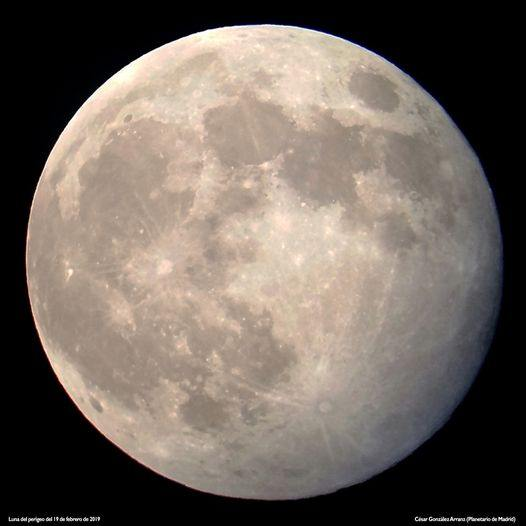
In the image you have the perigee moon that occurred on February 19, 2019, captured by our colleague César González using a mobile phone attached to the telescope located in the observation tower of the Planetarium.
Credit and image: César González Arranz (Madrid Planetarium).
In the hobbit, Companion master hobbit investigator David Day explores the brilliant web of verbal hocus-pocus that J. R. R. Tolkien delightedly spun in the Hobbit and The Lord of the Rings.
He reveals the myriad of crafty puns, riddles, hidden meanings, and mythical associations beneath the saga´s thrilling surface.
Intriguing to the uninitiated, and enchanting to the Tolkien enthusiast, The Hobbit companion can only enhance our enjoyment of Tolkien´s mysterious world.
The year 1997
Illustration by Linda Postman
Editorial 1010 Printing International LTD
This certificate recognizes my participation in training focused on future missions of the Artemis program—an initiative that will shape the course of lunar and Martian exploration in the coming decades. As a STEAM educator, integrating this material strengthens my ability to explain how NASA designs, plans, and prepares the steps that future generations of explorers will take.

This certificate recognizes my participation in training dedicated to the System-Wide Safety Project, a NASA initiative focused on enhancing safety across all levels of aviation. As a STEAM educator, integrating this content strengthens my ability to explain how engineering, risk management, and operations research combine to create more reliable and resilient flight systems.

This certificate recognizes my participation in training focused on the return and reentry of Artemis I—one of the most complex and demanding phases of any space mission. As a STEAM educator, integrating this material strengthens my ability to explain how physics, thermal engineering, and navigation combine to bring a spacecraft safely back home.

This certificate recognizes my participation in training focused on effective strategies for teaching STEM to educators and families. As a STEAM educator, integrating this content strengthens my ability to create clear, accessible, and engaging learning experiences, both in the classroom and in community settings.

This certificate recognizes my participation in training dedicated to Advanced Air Mobility, a NASA initiative that seeks to transform how we travel by air through safer, more efficient, and more accessible technologies. As a STEAM educator, integrating this content strengthens my ability to explain how aviation is evolving toward smarter and more sustainable systems.

This certificate recognizes my participation in training focused on the role models who inspire the Artemis Generation. As a STEAM educator, integrating this content strengthens my ability to demonstrate how personal journeys, diversity, and dedication within NASA serve as sources of motivation for students and future explorers.

Is a classic World War I story that focuses on Italy, France, and Britain in the Great War.
This book is a piece of war propaganda by H.G. Wells which was published in North America under the title Italy, France and Great Britain at War (the subtitle of the British original).
With the exception of the opening piece, its chapters were published as articles in the press.
Although he proclaimed at the beginning of the volume that "I declare myself an extreme pacifist", Wells strongly supported Britain's war against Germany "in the hope that thus we and the world can get rid of the German will to power and all". its humiliating and disgusting consequences from now on forever.
War and the future is divided into four parts. In the first part, titled "The Death of the Effigy", Wells argues that "the great man in this war is the common man", sketching a portrait of General Joffre as "a single figure who represents the best quality of warfare." ally", due to his "leadership without vulgar ambitions... It is as if it were the ordinary common sense of men, incarnate." In an account of a visit to the King of Italy, "the first king I ever knew", Wells is impressed by the monarch's lack of pomp and regality.
The second part, entitled "The War in Italy" (August 1916), describes the city of Udine and the mountain warfare, as well as a visit to Verona, Venice, and Milan.
The third part, "The Western War" (September 1916), describes visits to the Western Front near Arras and Soissons in France. Wells expresses his confidence that aerial dominance methods, combined with photography, have allowed the Allies to develop tactics that will surely defeat Germany.
Wells praises the British soldiers but criticizes the officer corps for its rigidity of mind. He emphasizes that new technologies have transformed the art of warfare in ways that military professionals are too slow to comprehend. In particular, fighting in disciplined formations and cavalry are no longer of military importance, while "artillery is now the most essential instrument of war." Wells describes a tour of a munitions factory given by André Citroën. He devotes a chapter to tanks as "the beginning of a new phase of warfare" and notes that in 1903 he had described a tank in a short story ("The Land Ironclads").
The final part of War and the Future is entitled "How People Think About War" and addresses a variety of topics:
- The inability of contemporaries to understand the nature and causes of war;
-The psychology of what he calls "the profitable pacifist" (willing to accept any kind of peace), origins that he finds in "the resentful employee", and the "conscientious objector"
-The effect of war on religious thought;
-French and Italian doubts about the British;
-The effect of the war on future labour relations;
-The prospects of ending the war. On the latter issue, Wells saw a chance for victory in 1917, but conceded that "the universally detested war may continue until 1918 or 1919."
Wells said that "the United States should finally take responsibility for a world peace agreement.
In general, it is a slow book, but with an interesting vision of the war from the ideological point of view of the English Empire.
This certificate recognizes my participation in training focused on the role models who inspire the Artemis Generation. As a STEAM educator, integrating this content strengthens my ability to demonstrate how personal journeys, diversity, and dedication within NASA serve as sources of motivation for students and future explorers.

Grateful to be part of Global Astronomy Month and to contribute to the mission of One People, One Sky. Science outreach continues to be a bridge that unites us.

This certificate recognizes my participation in training focused on 3D printing applied to sustainable aviation. As a STEAM educator, integrating this content strengthens my ability to explain how new manufacturing technologies can transform aeronautical design, leading to solutions that are more efficient and environmentally responsible.


These observations are being used by astronomers to understand how the black hole at the centre of the Milky Way galaxy, known as Sagittarius A* (or simply Sgr A*), interacts with and benefits from its environment, which is 26,000 light-years away from Earth.

One of the main goals was to capture X-ray flares. These flares are believed to be driven magnetically similar to the Sun's but can be tens to millions of times more powerful. The EHT observes flares approximately every day in the sky, which is slightly larger than the event area of Sgr. A*, the point at which there is no return for the matter that falls inward. A second goal was to get a better understanding of what's happening on a larger scale. The EHT result shows striking similarities to M87*, which was the last black hole it imaged. However, the larger picture is more complex.

"If the EHT image shows us the eye of a black hole hurricane then these multiwavelength measurements reveal winds and rain equivalent to hundreds, or even thousands, of miles beyond," Daryl Haggard, McGill University, Montreal, Canada, one of the leading scientists in the multiwavelength campaign. "How does the cosmic storm interact with, and even disrupt, its galactic environment?"
One of the most important questions about black holes is how they gather, ingest, expel, or ingest material at near-light speed. This is called "accretion" and is essential to the formation of stars, planets, and black holes of any size throughout the universe.

Chandra images of hot gases around Sgr A*, which are vital for accretion studies, tell us how much material is captured by nearby stars by the black holes' gravity and how much makes it to the event horizon. These critical details are not available using current telescopes for M87* or any other black holes in the universe.
"Astronomers agree on the basic facts -- black holes have material swirling about them and some of that falls across the event-horizon forever," Sera Markoff, a coordinator of multiwavelength observations at the University of Amsterdam in the Netherlands. "With all the data we have gathered for Sgr. A*, we can get a lot more than this basic picture."
The large international collaboration of scientists compared data from NASA's high energy missions and other telescopes to state of the art computational models. These models take into account factors like Einstein's general theory and effects of the magnetic field, as well as predictions about how much radiation material around the black holes should produce at different wavelengths.

Comparing the models to the measurements suggests that the magnetic field surrounding the black hole is strong. The angle between the line of sight to the black holes and its spin axis is also low, less than 30 degrees. This means that we see Sgr A* from our vantage point more than we do from side-on. It is remarkably similar to EHT’s first target M87*.
The EHT observations also revealed that the researchers were able to capture X-ray outbursts from Sgr. A*. One was faintly seen with Chandra, Swift, and another moderately bright with Chandra. Chandra regularly observes X-ray flares similar in brightness to those seen with Chandra. However, this is the first time the EHT simultaneously observed Sgr. A*. This gives the EHT an exceptional opportunity to identify the responsible mechanism by using actual images.

This monster is far away, at 26,000 light-years, so it's unlikely that we will ever encounter any danger.

What is a "black hole"?
-A black hole is an area of space in which matter has collapsed on itself
-The gravitational pull on everything is so strong that even light cannot escape.
-The explosive demises of large stars will lead to the formation of black holes
-Some are even more massive than others and weigh billions of times as much as our Sun.
-It is not known how these monsters, which are found in galaxy centres, were created.
-It's evident that they are energizing the galaxy and will impact its evolution
-Grey presentation line
This is a technical tour.
EHT uses a technique called Very Long Baseline Interferometry (VLBI) to trick the system. This essentially combines eight radio antennas in a wide spacing to create a telescope that is the same size as our planet. This arrangement allows the EHT to measure the angle of the sky in microarcseconds. EHT team members speak of a sharpness in vision that is similar to seeing a bagel on top of the Moon.
Even so, supercomputing is required to create an image from several petabytes (PB = one million gigabytes).
A black hole's lens or bends can indicate that there is no light. However, the brilliance and power of matter bursting around the darkness and expanding out into an accretion disk is a clue to where it is.
This certificate recognizes my participation in training focused on understanding how an aircraft's shape influences its aerodynamic behavior. As a STEAM educator, integrating this content strengthens my ability to explain how geometry, engineering, and physics combine to create more efficient and stable flights.

Participating in this event hosted by NASA EPDC and Texas State University builds upon my prior training in design and engineering processes by adding a perspective focused on observing, imitating, and transforming ideas from the natural world. This approach enables me to enrich my educational programs with activities that connect biology, robotics, and creative thinking.

This certificate recognizes my participation in training dedicated to the launch of Artemis I, a milestone marking the beginning of a new era in lunar exploration. As a STEAM educator, integrating this content strengthens my ability to explain how the most critical moment of any space mission—liftoff—is coordinated, executed, and monitored.

This certificate recognizes my participation in training focused on the ground systems that enable the launch and operation of space missions. As a STEAM educator, integrating this content strengthens my ability to explain how engineering, logistics, and technology combine on the ground to allow a mission to lift off into space.


